

is the 'certainty crusade' quietly ruining your life?
the answer is probably yes. so let's fix it!

Raise your hand if you routinely:
look at every restaurant in a 2 mile radius before choosing dinner
read the menu online and choose your meal before you even arrive at the restaurant
browse through 200 Netflix options before choosing one (or maybe even getting too frustrated by the whole ordeal and deciding to watch nothing after all)
🙋🏼♀️
If you’re guilty of any of these actions, you’ve fallen victim to the “certainty crusade,” or the idealogical campaign driven by a rigid demand for absolute certainty, truth, or stability. But don’t worry, you’re not alone—I’m as much a victim of the crusade for certainty as anyone.
In non-research speak, the certainty crusade shows up in our lives, leaking into tiny, “stupid” choices and quietly draining us of joy and serendipity. It’s not necessarily about who we marry or whether we move across the country; rather, it’s about the nights we lose to menu‑scrolling. Or the way we can’t just walk into a bar and see what happens because we need to be sure the vibes and the cocktails and the bathroom tile are all ✨perfect.✨
Today I’m breaking down the four major research findings around the certainty crusade—and, of course, providing some tangible ways to break free and live a more joyful, serendipitous, whimsical life.
Throughlines is a newsletter filled with creative exploration, intellectual deep-dives, and novel-writing updates written by Ashley Hackett. If you enjoy this piece, please consider subscribing (free or paid!) or sending me a tip. Thank you for reading!
1. Choice overload: Too many options really do fry your brain.
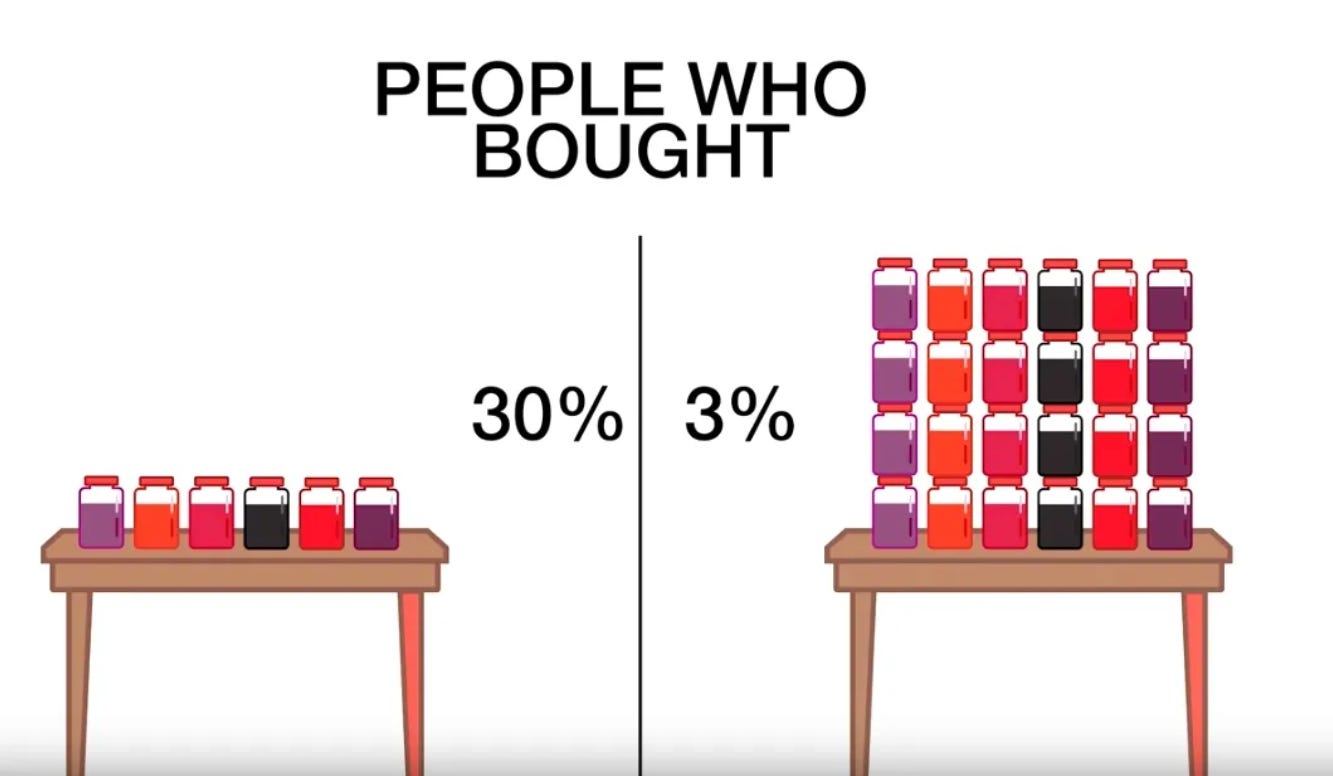
Back in 2000, Iyengar and Lepper conducted a study on consumer behavior using jams as their subject. They found that while a display table featuring 24 different types of jams attracted more interest, it resulted in significantly fewer purchases compared to a table with only 6 options. This phenomenon, known as choice overload, demonstrates that offering too many choices can overwhelm consumers and hinder their decision-making process.
The study, which has been quoted extensively and involved in several more recent meta-analyses, also shows that when you go from a few options to tons, people are more likely to either 1) freeze and not choose at all; 2) pick something by default (the first, last, or safest); or 3) feel less satisfied afterward, even if the choice was actually fine.
Intuitively, this makes sense to me—when I’m confronted with a restaurant menu that’s five pages long, I tend to take way too long trying to pick out the perfect meal. Sometimes the waiter comes too quickly and I panic: what if I missed a dish that I would like even more than the fried chicken sandwich with kimchi aioli?!
‘Choice overload’ also explains the dreaded Netflix paralysis and “three Yelp tabs open, still hungry” problem.
And let’s not ignore dating apps—I may be married now, having miraculously met my spouse on Hinge, but before that, the endless supply of theoretical ‘options’ was paralyzing. There is such a thing as too many fish in the sea, I think.
The research‑backed takeaway here: Our brains do better when we design our environment to offer fewer, good options instead of all possible options.
2. “Maximizers” are less happy than “good enough” people.
Barry Schwartz’s work on maximizers vs. satisficers shows us that maximizers—people who try to find the “best possible” choice—ruminate more, feel more regret, and report lower happiness and life satisfaction, even when their objective outcomes are better.
This one really threw me for a loop—you mean to tell me that picking the BEST choice can actually make me less happy?! Girl, now I’m pissed off.
But according to the research, it’s true: Satisficers (a portmanteau of the words ‘satisfy’ and ‘suffice’) are people who would rather make decisions quickly, happily settling for ‘good enough.’ In short, satisficers go with their gut. And they’re happier for it.
This goes against everything I (and, I dare to guess, many of you reading this) believe in: I must pick the correct activity/meal/show/restaurant because I am a responsible, optimized person who makes informed, evidence-based choices.
For younger women marinated in “have it all” messaging, the maximizing instinct feels like maturity: You’re doing your homework! You’re weighing the options! You’re not like those messy people who just…pick a bar and go. But the data suggests maximizers trade away actual satisfaction in exchange for imaginary optimality and constant second‑guessing.
I’m rethinking this frame of mind now. Of course, do your deep research on things that really matter, like who you marry or which local officials you vote for (pls vote). But the certainty crusade really is slowly making us miserable in everyday scenarios where the cost of our decisions is negligible.
Applied to our lives, this suggests an experiment: practice being a satisficer on purpose in low‑stakes domains. Declare that TV, Tuesday dinners, or weeknight plans are “good‑enough zones.” Give yourself three minutes to choose a show, and whatever is on the screen at the end of the timer is what you watch. Ask not “Is this the best?” but “Is this good enough for tonight?” Then notice how little it actually matters—and how much relief comes from just…deciding.
3. Intolerance of uncertainty literally causes indecision.
Newer work on intolerance of uncertainty (IU) finds that if you experimentally crank up people’s “I hate not knowing” feeling, their indecisiveness goes up too—even for personally relevant everyday stuff.
And hello, “correlation vs. causation” people, this is actually a causal relationship!
Tangibly, we see this when we have to be sure that the restaurant offers what we want, even though the worst-case scenario is that we just order something slightly mid and then eat again tomorrow. (I’m obviously not talking about folks with food allergies here; please keep the whataboutisms to a minimum.)
This is the certainty crusade in its purest form: the belief that if we just gather enough information, we can escape the discomfort of not knowing how the night will go. But the studies suggest the opposite dynamic is at work. Avoiding uncertainty actually strengthens the fear of getting it wrong; approaching minor uncertainty weakens it.
One way to quietly rebel is to treat daily life like exposure therapy: once a day, make one small decision without extra research. Walk into a bar without checking Google Maps. Let your friend pick the restaurant. Start the first movie that looks vaguely interesting instead of watching six trailers. The point isn’t to prove you’re chill; it’s to show your nervous system, over and over, that nothing catastrophic happens when you don’t know every variable in advance.
4. Minorities are socialized into chasing perfection, which spills into tiny choices.
There’s growing research evidence (though most of us have long known this at least anecdotally) minorities—people of color, women, queer people—are trained into socially prescribed perfectionism, or the sense that other people expect them to be flawless: high‑achieving, considerate, aesthetically correct, never careless.
That perfectionism shows up not just in grades, looks, and careers, but also “performing” taste (the right show, right restaurant, right vibe) and fear of visible “errors” (a dud bar, mid meal, boring movie when you had friends over). If you’ve ever felt weirdly ashamed when a place you chose turned out to be mid, that’s socially prescribed perfectionism whispering that you should have known better.
I’d argue that although the certainty crusade feels like an individual neurosis, it can also show up as a gendered and/or racialized survival strategy in a culture that views minorities’ missteps in a harsher light.
So what do we do with all this?
As well-versed in the intricacies of the certainty crusade as I am (read: I’ve been researching it for 1 [one] week), I am still trying to figure this out. The other day I caught myself agonizing over a happy hour menu and decided to just order something that sounded “good enough.” And you know what? That pisco spritz was delicious.
I’ve gleaned from my research that while no one action will turn you into a whimsical chaos fairy overnight, there are a few small, concrete actions you can start taking to chip away at the certainty crusade’s influence over your life:
Shrink the menu. Use hard limits (three tabs, five minutes, one shortlist) when choosing shows, restaurants, outfits, etc.
Design “good‑enough zones.” Pick a few domains—maybe streaming, weekday dinners, or walk‑in bars—that are explicitly for satisficing. Your standard is “good enough for tonight,” not “the best I could have done.” I personally will be doing this with TV shows.
Do one uncertainty rep per day. Choose one thing without advance Googling. Say yes to the first cafe you walk past. Your only job is to notice that you survived, and maybe even had fun.
The certainty crusade will always promise you safety if you just research a little more. The science—and, frankly, our actual lives—suggests something quieter: Joy tends to arrive through the door you didn’t vet in advance.
This is so relatable! I’m thinking of how this “need to know” mind relates to your reflections in your recent essay on death/dying. Life’s just one big mystery we can’t google our way thru, and ChatGPT can’t give us the answers to why we’re here and what happens to us. So the little actions of presence (exposure therapy as you say!) I do believe are practice for grander life surrender! Thanks for sharing Ashley I enjoyed this and I love knowing the science!
This really resonated with me, thank you. When I was a kid growing up we had two TV channels. There was always something to watch. Now I have Netflix, Prime and Disney, I can never decide what to watch and end up watching something I've seen before!